Participant-specific training

Train every staff member on the person they support. Then prove it.

Training & eTracking turns each person's ISP and plans into a training your staff complete in person, with check-in, quizzes and signed sheets kept on that person's record.

See it in action

From the ISP to a trained team, with proof

Watch a QIDP add a person's ISP, build a training about that person, present it with QR check-in and sign the training sheet in the app. Then see the staff member's side: the quiz and the cleared record.

Walkthrough, 4:08, with narrationFictional demo organization and participant

Read the transcript
  1. Every person you support has a plan. Here is how Training and eTracking Solutions turns that plan into training your staff complete, with proof that they did.
  2. This is Dana Reed's record: her ISP year, the staff assigned to her, and what each of them still needs.
  3. Assign the DSPs who work with Dana. Each one shows as not trained until the plan has been covered with them.
  4. Instead of writing that training yourself, create participant-specific training.
  5. Add the ISP. The workspace reads it, scans included, and summarizes it. Documents, notes, presentations and sessions all stay on Dana's record, year after year.
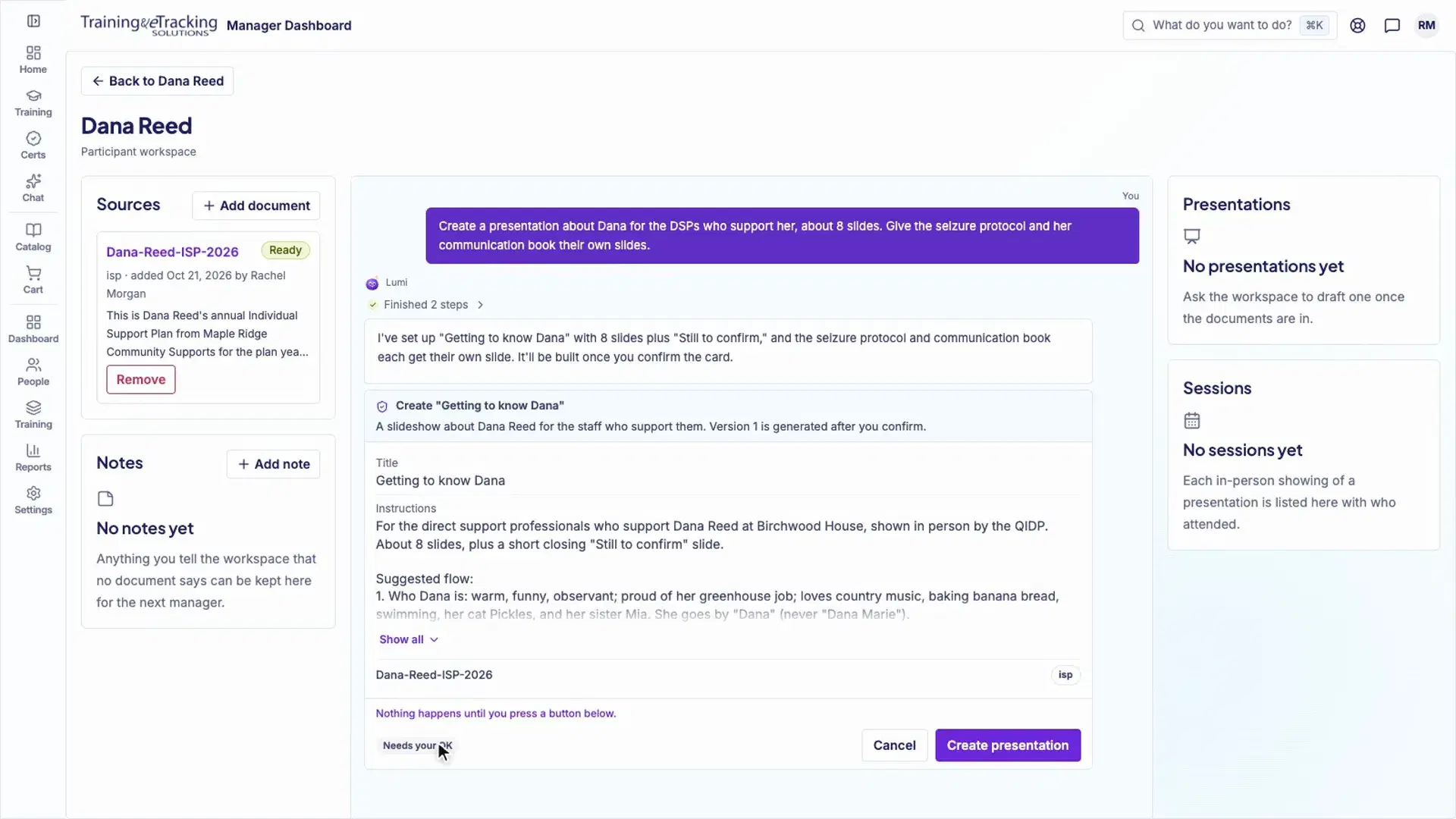
  6. Then describe the presentation you need. It plans one from the ISP, and nothing is created until you confirm.
  7. The card shows the title, the plan for each slide, the sources it will read, and the training types a session will cover.
  8. A couple of minutes later, the presentation is ready.
  9. Every slide comes from Dana's plan, with speaker notes for whoever presents it. The seizure protocol gets its own slide, step by step.
  10. Want something changed? Write a note on the slide and apply it. Only the slides you note are rewritten.
  11. When it's right, present it, straight from the app.
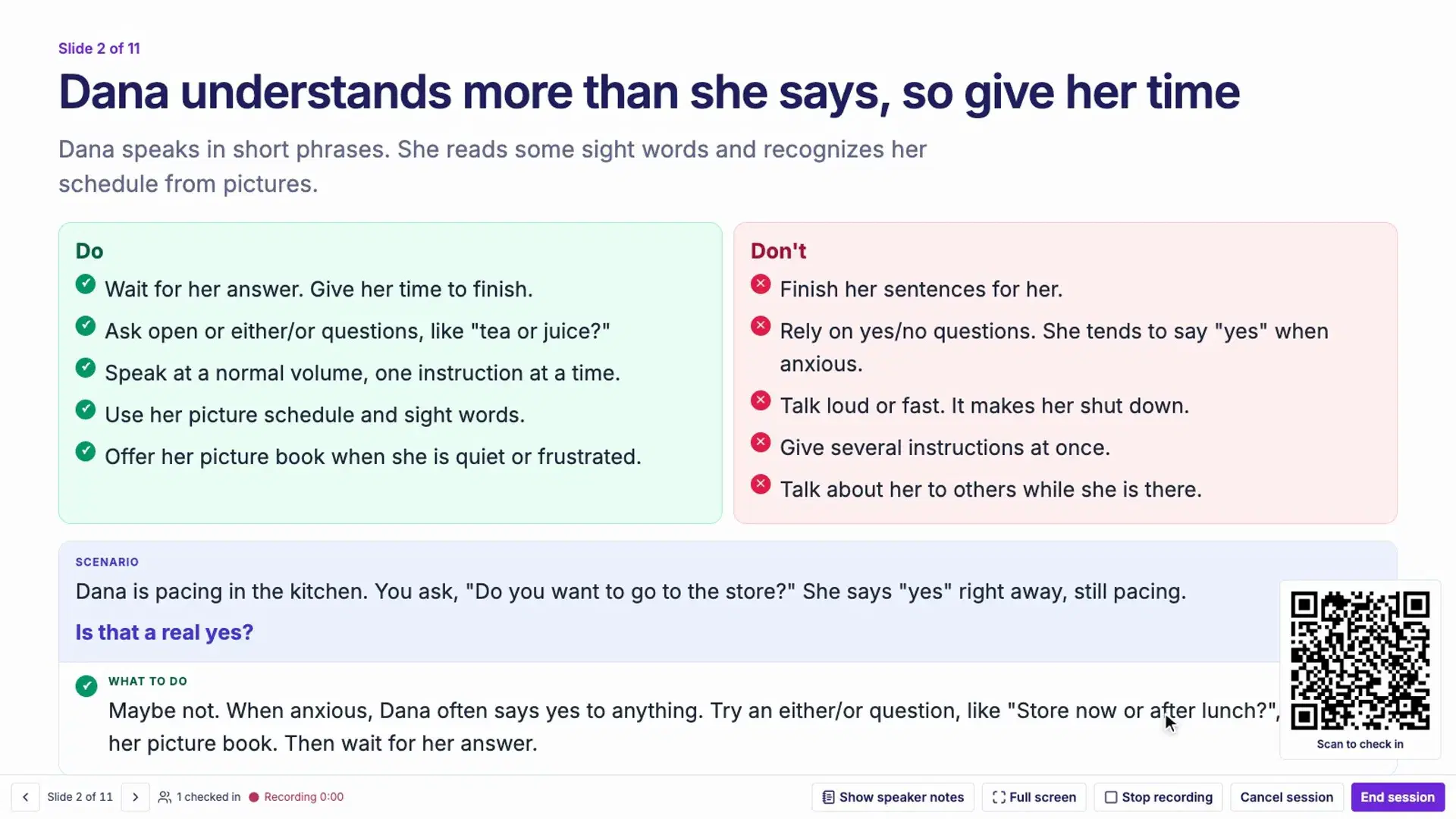
  12. Every slide carries a QR code. Staff scan it with their phone to check in.
  13. On the presenter's screen, the count updates as people arrive.
  14. Record the session, audio or camera, so anyone who missed it can watch later, alongside the slides.
  15. When you end the session, confirm who attended. Then choose what each person needs before they are marked trained: a quiz written from the presentation at the difficulty you pick, a training sheet you sign for each attendee, both, or neither, which marks them trained right now.
  16. On Jordan's side, the session is waiting on the participants page, with the recording for anyone who wants to watch it again.
  17. The quiz is five questions from the presentation. Eighty percent passes, and it explains every answer.
  18. Jordan is done. The sheet is the presenter's to sign.
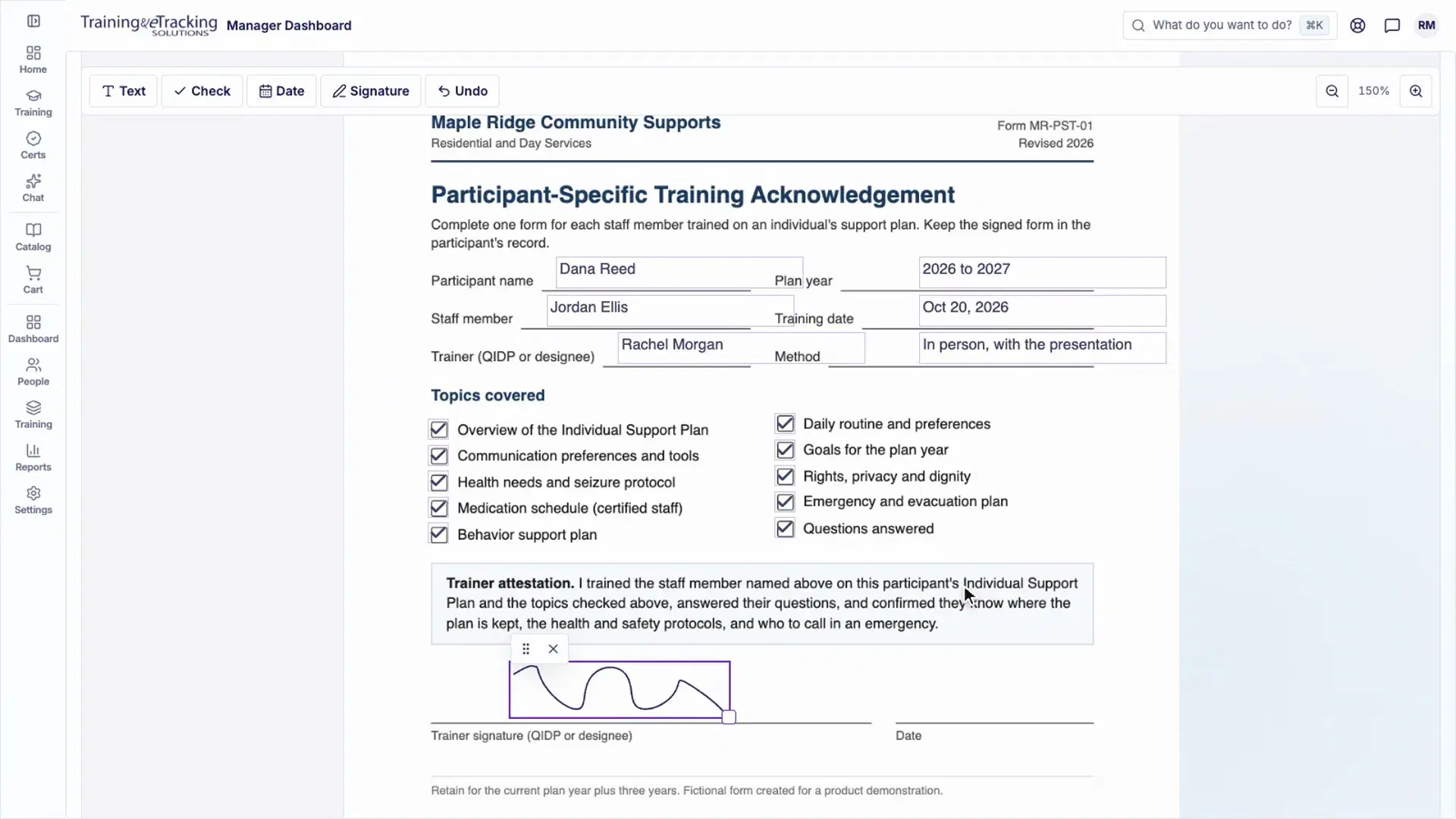
  19. The training sheet is your own form, filled and signed by the presenter in the app, straight from the session page. Type anywhere, check the boxes, add the date, and sign with a mouse or a finger. No printing, no scanning.
  20. Then sign, right on the sheet.
  21. It is saved as a PDF in Dana's record, and the presenter can reopen and correct it later.
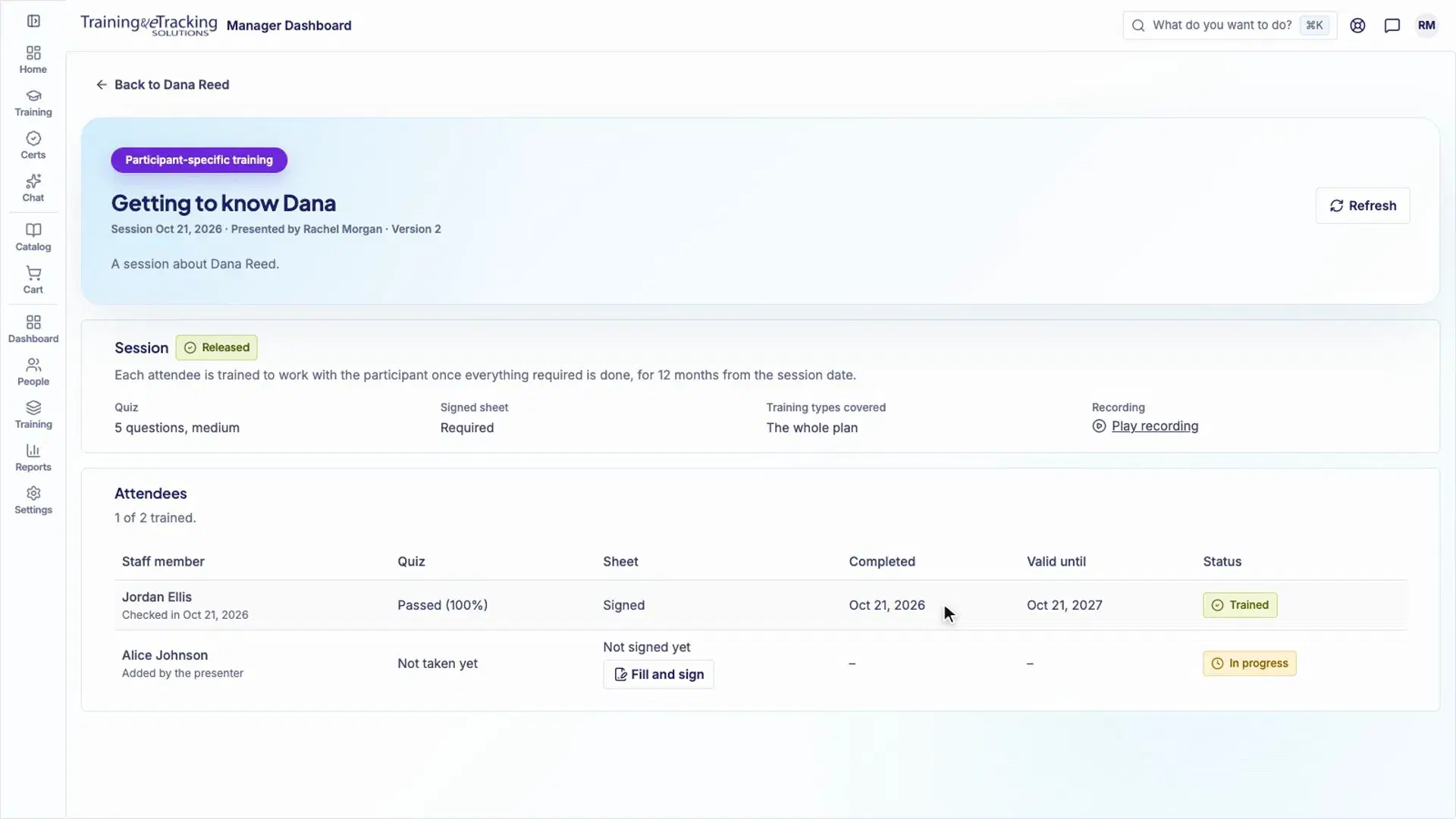
  22. Back on the record, Jordan is cleared, with the session, the quiz and the signed sheet as proof. Alice still has her quiz to take. Marcus was not there, so he is still not trained.
  23. Session training counts for twelve months. When the plan is revised or the year ends, the grid asks for renewal, so nobody works alone on an outdated plan.
  24. Participant-specific training. Part of Participants, in Training and eTracking Solutions.

How it works

A workspace for every person you support

Each participant gets a workspace where your QIDPs and supervisors build, present and track the training that is about that person, not a generic course.

A participant's workspace with the ISP added and a proposed presentation waiting for confirmation

Start from the person's own plans

Add the ISP, behavior support plan, health care plans and protocols to the person's workspace. It reads them, scans included, and keeps documents, notes, presentations and sessions on their record year after year. Describe the training you need, and nothing is created until you confirm.

A presentation slide about a participant, with a QR code for staff check-in

Present it in person, with check-in on every slide

Every slide is written from the person's plan, with speaker notes, and you can revise any slide with a note. Present straight from the app: staff scan the QR code on any slide to check in, and you can record audio or camera for anyone who missed it.

An organization's own training acknowledgement form, filled in and signed inside the app

A quiz, a signed sheet, or both

When the session ends, confirm who attended and choose what each person needs before they count as trained: a quiz written from the presentation, your own training sheet filled and signed in the app, or both. No printing, no scanning.

A session record listing attendees, quiz results, signed sheets and the date each training is valid until

Proof on the record, renewals on time

Each staff member's clearance for that person shows the session, the quiz score and the signed sheet. Training counts for twelve months, and a new ISP year or a revised plan marks staff Renewal required.

One platform

Beside your state's compliance pathway

Participant-specific training is part of the same human services LMS and compliance platform your staff already use for their courses.

State staff-training pathways

Where your state defines DSP requirements, each one is mapped to the courses that meet it, with its citation, cadence and evidence.

One Compliance tab

Course and certification compliance and participant-specific clearance sit on the same Compliance tab, so you can see who is ready to work with whom.

Read-only access for monitors

We can give a state monitor or auditor a read-only login that shows the records and the signed sheets.

Where it fits

States that require training on the individual

These rules ask providers to train staff on the specific person they support, and to show it. Participant-specific training gives you one place to deliver that training and keep the record.

Training on each individual, for direct support staff

Staff are trained on each person's own plan and needs, usually before they work alone with them.

States that require training on each individual a staff member supports
StateWhat the rule asks forSource
AlabamaADMH Division of Developmental DisabilitiesTraining specific to each individual served, including their person-centered plan and service implementation plans, before staff are assigned to provide direct supports.ADMH Operational Guidelines Manual §B.4.1
ArkansasDHS Division of Developmental Disabilities ServicesBeneficiary-specific training on each person's non-clinical treatment plan, diagnoses and medical needs, medication plan, behavior plans and emergency procedures before unsupervised contact, refreshed every other year.CES Waiver Agency Provider Standards §303
ColoradoHealth Care Policy & FinancingTraining specific to each individual served, including medical or behavioral protocols, supervision, dietary and daily-living needs, before unsupervised contact.10 CCR 2505-10 §8.7409.D
ConnecticutDepartment of Developmental ServicesTraining on each individual's health, safety and programmatic support needs within 30 days of hire and before working alone, and again annually and/or as changes occur.DDS Operations Center Memo 2020-06; QSR indicator D35
District of ColumbiaDepartment on Disability ServicesPhase II training on each person's specific needs, such as the ISP, behavior support plan, health care management plan, protocols and medications, before staff work alone with them and whenever the ISP or BSP changes, with a signed training record.DDS DSP Training Procedure, Phase II
IdahoDepartment of Health and WelfareParticipant-specific training on medical and health requirements and assistive devices before delivering services, and again when the plan of service or the participant's condition changes.IDAPA 16.03.21 §302.03–.04
IndianaFSSA Bureau of Disabilities ServicesTraining on individual-specific treatments and interventions, including seizures, behavior, medication side effects, diet, swallowing, crises and health concerns, before anyone works with the individual.460 IAC 6-14-4
KentuckyDBHDID, Supports for Community Living waiverIndividualized instruction on the person-centered service plan of each participant supported, with competency verified, before working independently.907 KAR 12:010 §3(3)(gg)
LouisianaLouisiana Department of HealthTraining in the care each beneficiary needs, with verified competency on their emergency evacuation plan, before a worker is solely responsible for them.NOW and ROW waiver manuals, §32.6 and §38.6
MinnesotaDepartment of Human ServicesInstruction on each person's support plan, abuse prevention plan, and medication and equipment procedures before unsupervised contact, and again whenever those plans are revised.Minn. Stat. 245D.09, subd. 4a
MissouriDMH Division of Developmental DisabilitiesTraining in each individual's current person-centered support plan and addenda within one month of the plan's implementation or of hire.DD Waiver Manual, service staff requirements
NebraskaDHHS Division of Developmental DisabilitiesOrientation on the individual support plan and any medical, behavioral or safety protocols of each participant served, before working alone, with competencies verified.404 NAC 4-003.03
New HampshireDHHS Bureau of Developmental ServicesTraining on each individual's profile, health requirements and protocols, safety plan and behavior or risk plan before working directly with them; supervisors check understanding before the start and every year.He-M 506.05
New JerseyDivision of Developmental DisabilitiesSpecialized training about each individual supported, including the ISP, behavior plans, and medical and mealtime needs, before sole responsibility or within 60 days of hire, and as needed.Supports Program Manual, Appendix E; DSP Training Guide
New MexicoHealth Care Authority, Developmental Disabilities Supports DivisionIndividual-Specific Training on each person's ISP and plans, such as healthcare, aspiration risk, behavior and risk plans, every ISP year, when plans change and when a new DSP is assigned, recorded on training rosters.DD Waiver Service Standards §17.9
North CarolinaDepartment of Health and Human ServicesTraining to meet the needs of each client as specified in their treatment or habilitation plan.10A NCAC 27G .0202(g)
North DakotaDHHS Developmental Disabilities SectionCompetency on each consumer's plan and related behavior support plans, plus client-specific health and safety information, before sole responsibility and every year.Policy PI 18-05
OhioDepartment of Developmental DisabilitiesTraining specific to the individual service plan of each individual a DSP will support, before providing services, with a competency method the agency defines.OAC 5123-2-08, Appendix C
OklahomaOKDHS Developmental Disabilities ServicesIndividual-specific in-service training named in each person's Individual Plan, completed before working with them unless the Team sets other timelines, with a Team member verifying skills.OAC 340:100-3-38.1(e)
OregonODHS Office of Developmental Disabilities ServicesKnowledge of the ISP and the medical and behavioral supports of every individual served, with competency demonstrated before working unassisted.OAR 411-325-0025(6); DSP Core Competencies
TennesseeDDA and TennCareTraining on all services specific to each person before working unsupervised, documented on a skills checklist, and repeated when the person's plan changes.TennCare LTSS Training Requirements Protocol §III
TexasHHSC, Home and Community-based ServicesDocumented training specific to each individual's needs before service provision and at least every 12 months, with observed competency.26 TAC §565.7(b)(2)
VermontDAIL Developmental Disabilities Services DivisionIndividual-specific training on behavior, health and safety, communication and the ISA before working alone, repeated for each different individual.HCAR 7.100.10(d)
VirginiaDBHDS and DMASSupervisor-confirmed competencies, including each individual's health and behavioral support needs and plans, before working without proficient staff, in full within 180 days of hire, and reconfirmed every year.12VAC30-122-180; 12VAC35-105-665.D; DMAS P241a
WashingtonDSHS Developmental Disabilities AdministrationTraining on the current instruction and support plan of each client before an employee works alone with them.WAC 388-101D-0095
West VirginiaBureau for Medical Services, I/DD WaiverMember-specific training on crisis plans, behavioral and habilitation needs, diagnoses, medications and side effects before providing services, and at least annually.IDDW Manual Ch. 513, §513.2
WyomingWyoming Department of HealthParticipant-specific training before working alone, before the plan of care starts and before any plan change, with a record of how the trainee showed understanding.Medicaid Rules Ch. 45 §15

Training on a person's specific plan

The rule covers part of the work, such as behavior support plans, health procedures or orientation to each person's needs.

States that require training on a person's behavior, health or service plan
StateWhat the rule asks forSource
DelawareDivision of Developmental Disabilities ServicesA 30-day orientation checklist on each person's plan, medication support, health and dietary needs and behavior strategies, signed by the employee and supervisor.DDDS Training Policy, Appendix B
FloridaAgency for Persons with DisabilitiesPerformance-based training for staff who implement a person's behavior analysis plan.Rule 65G-4.009(8)
GeorgiaDBHDDTraining on each individual's care-plan protocol should take place before working with them, where applicable, and training on their specific medications and side effects is due within 60 days of hire and annually.DD Provider Manual, Part II §1, item 13.b
HawaiiDOH Developmental Disabilities DivisionSupervisors watch return demonstrations of each participant's plan strategies before a worker starts with them; behavior support plan training comes from the plan's author.Waiver Provider Standards Manual §3.7-C, §1.7 and Training & Consultation standards
MassachusettsDepartment of Developmental ServicesAll mandated and individualized training, including dining and medical protocols, behavior support plans and risk plans, before working alone with an individual.DDS memo, May 2025; 115 CMR 7.05(3)(d)
MichiganMDHHSDSPs serving waiver beneficiaries are trained in the beneficiary's individual plan of service.Medicaid Provider Manual §2.4 and provider qualifications
MississippiDepartment of Mental HealthFace-to-face training on a person's behavior support plan from the behavior specialist, with retraining when the plan changes.DMH Operational Standards, Rules 30.2 and 46.3
MontanaDPHHS Developmental Disabilities ProgramSpecial training outlined in the person's Personal Support Plan within 30 days of hire.0208 Waiver Provider Manual, staff training grid
New YorkOPWDDStaff supporting a person with a behavior support plan are trained in that person's plan, and retrained when it changes or at least annually.14 NYCRR 633.16(i)
Rhode IslandBHDDH Division of Developmental DisabilitiesPerson-specific training and nurse-documented competency before staff perform an individualized health procedure, reassessed every year.212-RICR-10-05-1 §1.11.8
South CarolinaBHDD Office of Intellectual and Developmental DisabilitiesStaff implementing a behavior support plan are trained with modeling, rehearsal and feedback, and a signed training record is kept with the plan.Residential Habilitation Standards RH5.4
UtahDHHS Division of Services for People with DisabilitiesClient-specific medication, medical and dietary, routine and functional-limitation training within 30 days of hire; behavior support plan training before the plan is used.Community Supports Waiver, Appendix C; R539-4-4(7)
WisconsinDepartment of Health Services (CBRF)Orientation on the assessed needs and individual services of each resident before an employee performs any job duties.DHS 83.19(3)

Summaries of each state's rule as checked in October 2026, written in plain language. They are a starting point, not legal advice. Confirm current requirements with your state agency.

We are bringing technology and innovation to person-centeredness.

Ask yourself whether your organization is ready to make the jump, or the switch. We move your existing training records over for you.

See participant-specific training for my agency

Tell us a little about your agency and we'll walk you through it live, then give your team demo access.